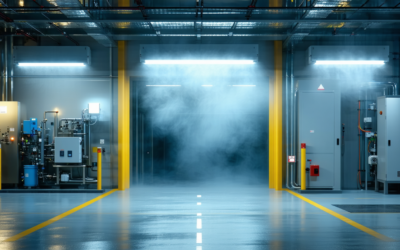
What is explosive dust?
Explosive dusts are volatile substances that are all around us. They can be found in various sectors, such as :
- the manufacturer
- the food industry
- metalworking
- wood
- etc.
They form when solid particles are dispersed in the air. In the presence of an ignition source, a chain reaction can occur, leading to the explosion of a dust cloud. Its concentration, particle size and surrounding conditions are decisive factors in avoiding this reaction.

What are the different classifications of explosive dusts?
The classification of explosive dusts is based on their reactivity to heat and their flammability. There are several classes, the most dangerous of which is hyper-reactive dust. These criteria are used to identify the specific hazards associated with each type of dust.
Here are some examples of classification systems for explosive dusts:
- The ATEX classification used in Europe
- NFPA 654, the standard used in the United States
- Internationally recognized IECEx certification
Besoin d’un devis ?
Produits de signalisations sonores et lumineuses, systèmes de mise à la terre, signalisation non ATEX, connections ATEX…
Focus on ATEX classification
- Group I: Dust present in underground mines subject to firedamp.
- Group II: Dusts present in other industrial environments.
- Category 1: Very high level of protection (zones 20, 21, 22).
- Category 2: High level of protection (zones 21, 22).
- Category 3: Normal level of protection (zone 22).
What are the different types of explosive dust?
Each type of dust has specific properties which determine the precautions to be taken when handling it. Stay alert and get to know them so you know how to adapt safety on your sites:
- Metal dusts: these include aluminum, magnesium and titanium. Their extreme reactivity means they must be handled with great care.
- Organic dusts: these come from substances such as sugar, flour or wood. These dusts can ignite rapidly and cause devastating explosions.
- Explosive coal dust: this is a by-product of the mining industry, and requires rigorous control to prevent accidents.
What are the criteria for classifying explosive dusts?
Dust explosion is a complex industrial hazard, influenced by a number of factors:
- Particle size: explosive dusts are generally very fine, which increases their explosion potential.
- The concentration of dust in the air: the higher the concentration, the greater the risk of explosion.
- Chemical composition: some substances are more flammable than others. The auto-ignition temperature, i.e. the temperature at which a substance can ignite without an external ignition source, should also be considered.
- Humidity : dry explosive dusts are much more likely to explode than damp ones.
You’ve learned about the various classifications of explosive dusts, based on their flammability, toxicity and behavior in the presence of an ignition source. With this information, you can better understand the hazards associated with these particles and effectively adjust your safety measures. To guarantee optimum protection, call on ADF Systems, suppliers of ATEX equipment, to equip you with the best safety solutions.