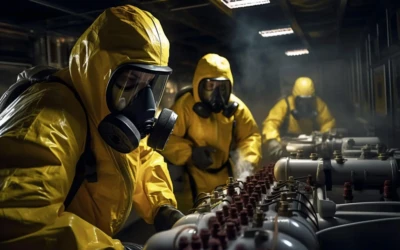
A real tool in the event of a crisis situation, the internal operations plan (POI) is designed to ensure the safety of property, people and the immediate environment of specific establishments.
In accordance with Articles L515-41 and R181-45 of the French Environment Code , it sets out the organization, response and resources required by the operator. Contents, establishments concerned, updates: here’s everything you need to know about the POI.
What is the Internal Operation Plan (POI)?
The internal operations plan or emergency plan applies to plants where a facility is likely to present technological risks to the health and safety of neighboring populations and the environment.
In fact, an IOP must be drawn up following a study of the hazards present in the various areas of a plant. This plan must take account of the elements identified in the study, including the various accident scenarios put forward.
The POI thus integrates the resources deployed by the plant itself, as well as those of the public emergency services, neighboring industries and, if necessary, outside companies.
If necessary, the operation plan is triggered by the plant manager or by the designated Director of Internal Operations (DOI).
While internal operating plans are mandatory for high-threshold SEVESO sites, they will also soon be required for low-threshold sites (January 1, 2023).
But it can also be made compulsory by prefectoral or ministerial decree for any facility classified for environmental protection (ICPE) subject to authorization.

What should a plant’s emergency plan contain?
First of all, the POI is drawn up and drafted by the plant manager, taking into account the hazard study and the various accident scenarios.
To guarantee its effectiveness, it must be forwarded to the Service départemental d’incendie et de secours (SDIS ) and shared with the various players involved in its implementation.
This includes in-house employees, employees of the private security company working on the site, and potentially also the various sites in the surrounding area.
The anticipation plan includes
- General presentation of the plant ;
- Site plans (location plan, access plan, network plan);
- Danger and alert levels and messages to be broadcast;
- The various means of transmission ;
- Risk levels determined according to the plant’s activities;
- Rescue organization and response ;
- The roles and responsibilities of those involved in the POI and their missions ;
Since January 1, 2022, the IOP must also include the means and methods planned for environmental remediation and cleanup, as well as the provisions planned to support off-site mitigation measures.
As of January 1, 2023, the contingency plan will have to include provisions for carrying out the first environmental sampling.
When to update the internal operations plan?
Updating the anticipation plan depends on the nature of the facility concerned:
- SEVESO low threshold: the POI is mandatory from January 1, 2023, with the obligation to test it every 3 years and update it if necessary.
- SEVESO high threshold: the OP is drawn up even before the plant is commissioned, and is subject to annual testing and compulsory updating every 3 years.
The training exercises scheduled at regular intervals are designed to assess the effectiveness of the POI, and to make up for any shortcomings by increasing the preparation and training of in-house personnel.
After each update, the plant manager is responsible for disseminating the changes and ensuring that the POI is shared with the organizations involved in its application.
Would you like to find out more about the internal operations plan?
ADF Systèmes makes it a point of honor to help you choose the products and solutions best suited to your industrial safety and risk management needs.