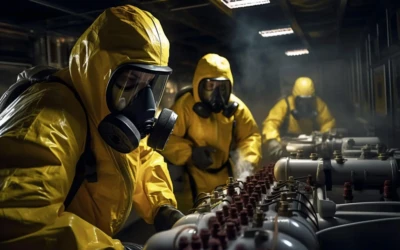
- Primary protection: limiting the risk of explosion at all costs.
- Secondary protection: eliminate all sources of ignition.
- Tertiary protection: to minimize the effects of an explosion if it cannot be prevented.
Here are our 7 top tips for choosing the right equipment and PPE to protect against explosions.
Defining the type of risk according to the type of industry
To do this, we need to understand the types of industries and risks that ATEX equipment and enclosures can be used in.
- I: grey mines
- II: surface industries
- G: equipment adapted to gas hazards
- D: suitable equipment for dust-related hazards
- GD: equipment suitable for use in gaseous and/or dusty atmospheres.
Note: these symbols must appear on the ATEX marking marking on equipment and appliances.
Identifying ATEX zones
According to current ATEX regulations, several zone categories can be distinguished:
| THE EXPLOSIVE ATMOSPHERE IS PRESENT… | GAS/VAPOR ZONE | DUST ZONE |
| …permanently or for long periods during normal operation | 0 | 20 |
| …occasionally in normal operation | 1 | 21 |
| …accidentally, in the event of a malfunction or for a short period of time | 2 | 22 |
Source : INRS

Determining ATEX equipment categories
All ATEX and non-ATEX electrical equipment and signalling systems in ATEX zones must comply with the technical requirements for the various zone types.
| RISK | ZONE | DEVICE CATEGORY | REGULATORY MARKING |
| Permanent risk | Zone 0 | Category 1 | CE Ex II 1 G |
| Zone 20 | Category 1 | CE Ex II 1 D | |
| Occasional risk | Zone 1 | Category 2 (or 1) | CE Ex II 2 G (or 1 G) |
| Zone 21 | Category 2 (or 1) | CE Ex II 2 D (or 1 D) | |
| Potential risk | Zone 2 | Category 3 (or 2 or 1) | CE Ex II 3 G (or 2 G or 1 G) |
| Zone 22 | Category 3 (or 2 or 1) | CE Ex II 3 D (or 2 D or 1 D) |
Know the different explosive groups
Gases and vapors are classified according to their sensitivity to ignition. There are three subdivisions:
- IIA – low flammability: acetone, propane, methanol, toluene
- IIB – high flammability: ethylene, town gas
- IIC – very high flammability: hydrogen, acetylene, carbon disulfide
As for dust, it is classified according to the size of its particles and its conductivity:
- IIIA – low: flammable lint
- IIIB – high: non-conductive dusts
- IIIC – very high: conductive dusts
Check temperature classes of ATEX equipment
This refers to the maximum surface temperature permitted in the presence of explosive substances. The surface temperature of explosion-protected equipment or Apparatus is designed to avoid becoming a source of ignition.
For explosive gas or vapour atmospheres, there are six classes of ignition temperatures :
Besoin d’un devis ?
Produits de signalisations sonores et lumineuses, systèmes de mise à la terre, signalisation non ATEX, connections ATEX…
- T1: > 450°C (max. surface temperature: < 450°C)
- T2 : > 450°… < 300°C ( < 300°C)
- T3 : > 300°…< 200°C ( < 450°C)
- T4 : > 200°…< 135°C ( < 200°C)
- T5 : > 135°… < 100°C ( < 135°C)
- T6 : > 100°… < 85°C ( < 85°C)
As for dusts, there is no flammability temperature classification. However, the maximum surface temperature is expressed in C°.
Pay attention to equipment protection categories (EPL)
According to the requirements of the ATEX Directive, Category II explosion-proof equipment is divided into 6 levels of protection: Ma, Mb, Ga, Gb, Gc, Da, Db, Dc.
These symbols combine a use, a design principle, a protection mode, one or more ATEX zones and a standard.
Knowing the protection index (IP)
The protection index (IP) defines the degree of protection provided by the external enclosure of ATEX equipment.
The first number visible on the IP indicates protection against the entry of solid bodies , while the second number indicates the degree of protection against liquid bodies.
- Solids: protection from 1 to 6 ;
- Liquid bodies: protection from 1 to 8 ;
Would you like more advice on choosing explosion-proof protective equipment?
ADF Systèmes makes it a point of honor to help you choose the products and solutions best suited to your industrial safety and risk management needs.