Industrial risk prevention in France is intrinsically linked to the location of high-risk industrial sites, more commonly known as SEVESO sites.
Although a number of industrial disasters have prompted European governments to review the framework for industrial activities, it was the European SEVESO Directive, created after the Seveso disaster in Lombardy, that formalized the need for EU member states to maintain a very high level of prevention, protection and safety in the face of industrial risks.
What is an industrial risk?
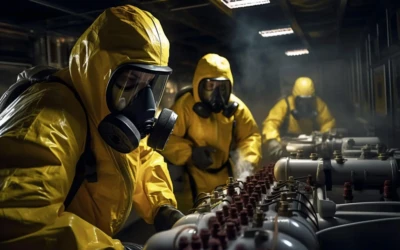
An industrial hazard is an accidental event occurring on an industrial site, with immediate and serious consequences for employees, neighboring communities, property and the environment.
They are called technological risks when they are directly linked to human activity.
The main manifestations of industrial risk are grouped into three typologies:
- Thermal effects: Fires with risk of burns, asphyxiation or poisoning.
- Overpressure effects: linked to an overpressure effect (ATEX atmosphere) resulting from a shock wave caused by an explosion. This entails the risk of eardrum damage, burns and asphyxiation due to combustible dust.
- Toxic effects : following the dispersion of toxic substances (ammonia, chlorine, phosgene) in air, water or soil, there is a risk of toxicity through inhalation, ingestion or contact.
In order to limit the occurrence of such accidents and their consequences, SEVESO and ATEX sites must comply with specific regulations , as well as regular internal and external checks .
Industrial risks are defined as major when the probability of an accident is low, or even very low, but the severity is very high.
A technological risk is considered major when the probability of an accident is low, but its severity is high.

What is the legal framework for industrial risk prevention?
The “Risks” Act
Since July 2003, France’s “Risques” law has provided a framework for controlling and reducing the hazards associated with technological industrial risks. It classifies SEVESO site hazards as follows:
- Manufacturers
- Nuclear
- Biological
- Chemicals
- Related to the transport of hazardous materials
- Etc.
The Risks Act is designed to protect both the site itself and the surrounding population. For this reason, it provides for a range of preventive measures such as :
- Tighter safety and compliance controls
- Tighter regulations
- Better information for local residents and employees
- The development of a tool to control urbanization and hazards in order to reduce risks at their source (PPRT).
Besoin d’un devis ?
Produits de signalisations sonores et lumineuses, systèmes de mise à la terre, signalisation non ATEX, connections ATEX…
The PPRT: an indispensable assessment tool
The PPRT (Plan de Prévention des Risques Technologiques – Technological Risk Prevention Plan) was drawn up under the French Risks Act in an attempt to control risks at source and protect exposed populations.
It includes not only internal safety measures, but also an emergency plan (ORSEC) and a communication plan for the general public.
Find out more about the PPRT methodology on Gouvernement.fr
Industrial risk prevention: what steps should you take internally?
The single document (DUER) enables management teams to determine the safety and prevention measures to be applied within the workforce and on the industrial site. It enables a collective protection plan to be drawn up, as well as an individual protection plan for employees.
These may include requests for employee training:
- ATEX risk management
- Reducing the risk of fire
- Handling toxic or abrasive products
- First aid
- Etc.
Or work instructions and procedures designed to limit risks and protect against hazards.
It can also involve modernizing facilities in order to :
- Reduce risks and liquid and gas leaks.
- Clear aisles for optimum evacuation.
- PurchaseATEX warning systems andwarning lights and horns.
In addition, reliable, standardized PPE is acquired for workers, and regular checks are carried out in every danger zone.
Do you work on an industrial site and wish to adopt a better safety policy in the face of risks? ADF Systèmes makes it a point of honor to guide you in your choice of the most appropriate products and solutions for industrial risk prevention.