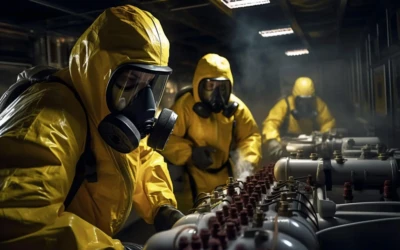
This approach makes it possible to identify the risks present for workers on site, and to implement a prevention and protection policy adapted accordingly.
How do you carry out an occupational risk assessment (ORA ) in an industrial environment?
What is a professional risk assessment?
Thanks to EvRP, industrial sites are able to identify, analyze and classify the risks associated with the activities of their employees.
Prevention and protection
This is step 1 in developing an effective developing an effective prevention and safety approach.
The assessment of occupational risks covers the technical, human and organizational dimensions of a site. It begins with a situational observation of each workstation and infrastructure, and culminates in the drafting of a single document.
Single document
This single document lists all EvrP results.
As such, it can be consulted by all employees, CHSCT members, employee representatives, as well as all those involved in site activities and employee well-being.
Legal framework
In France, employee protection is a legal requirement for employers (article L4121-1), who must do everything in their power to ensure the health and safety of their employees.
To find out more about the legal framework governing occupational risk assessment, see related articles.

How do you assess occupational risks?
According to the INRS definition, a risk is an event that is more or less uncertain, depending on the amount of information gathered about it. It concerns the possibility of an encounter between an individual and a latent danger.
There are four stages in the occupational risk assessment process.
1. Preparing for the assessment
During the assessment preparation phase, the first step is to set up a dedicated working group, but also to decide on its organization (coordinators, informants, project managers, etc.) depending on the size of the site.
Besoin d’un devis ?
Produits de signalisations sonores et lumineuses, systèmes de mise à la terre, signalisation non ATEX, connections ATEX…
Next, we distinguish between work units, which refer not only to workstations but also to work situations. The same employee may work in several different functions.
Next, we define the tools needed for the assessment (documents, lists, software, etc.), as well as all the resources required to carry it out.
Of course, it’s a good idea to inform employees of the progress of operations, especially if the assessment team is external.
2. Identify risks
The first step is to identify the hazards present: equipment properties, chemical agents, stress factors, etc.
The second step is to determine the conditions under which employees are exposed to these potential hazards.
This can be done by means of normative checks and verifications in the form of checklists, questionnaires, etc., but also byergonomic analysis of individual units – in situ – or by modeling and probability calculations.
3. Classify risks
After the analysis as such, the head of the facility classifies the identified risks, and then proposes defined actions.
Statistical data or comments from employees can provide guidance.
The aim is to determine the priority of certain actions and the planning of all future actions.
4. Set up preventive actions
After ranking and issuing the opinions of representative bodies (staff delegates, external bodies, etc.), the head of the establishment must implement the preferred actions.
The actions selected must comply with the 9 prevention principles in force.
In conclusion, occupational risk assessment in an industrial environment is essential, and must be supplemented by a chemical risk assessment. chemical risk assessment.
Do you work on a high-risk industrial site? ADF Systèmes makes it a point of honor to help you choose the ATEX materials best suited to your industrial safety and risk management needs.